


In major US housing markets, the strategies needed to successfully find value in existing housing stock may start with taking bigger risks. The small flips might be more dangerous than the big ones.
This letter walks through the underwriting, modeling, and returns for one house, and then discusses:
Why luxury homes might be a better risk adjusted bet than cheap, inexpensive homes with smaller payments;
What the data is saying about the different spots in the market - high, low, and middle pricing;
Why real estate investors haven’t always chased these; and
Why they should.
841 E Hayward - The Case Study
There’s a neighborhood in Phoenix that I love. The area is north-central Phoenix, and the specific area I love is in-between the 7’s. Phoenix was laid out in a grid - Central Ave runs north and south up the middle, Streets going east and Avenues west. Everything between the 7’s, 7th Ave and 7th Street, from roughly Northern all the way down to Downtown Phoenix, is downright charming.
They planted big trees here, in the 50’s and 60’s when these lots were built. They were largely set up with flood irrigated lots, and the lots are bigger, and don’t run in straight lines. The result is a delightful neighborhood of streets that have turns and bends, are green, verdant, have mature trees, average temperatures roughly 10 degrees less than the concrete and rock covered suburbs, and are increasingly more expensive year after year. As you can imagine, in a hot desert, anything green and cooler is a popular spot. On one street in the 7’s is 841 W Hayward, the house I just acquired.


The Plan
Expand the house from 1720 sqft all the way up to 2390. This will allow me to make it a true modern 4/3 floor plan - 2 primary bedrooms each with their own en-suite bathroom, two additional rooms that share the hall bath, a new inside laundry room, and a brand new butlers pantry that will be a delight to cook in. It’ll also convert the carport to a full garage, and remodel the pool area so it’s fun to hang out.
The Underwriting Model
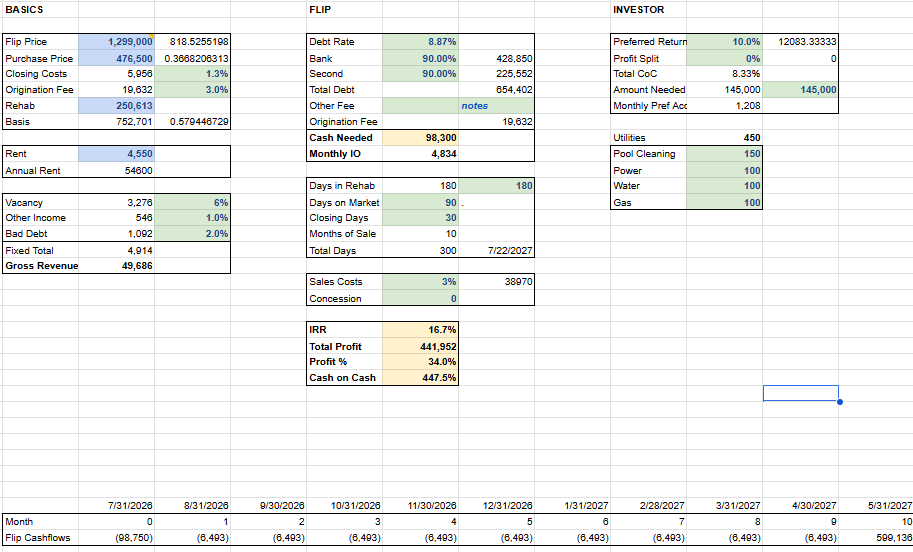
1.29M exit is the stretch price but it’s definitely in the realm of possibility. I’m much more likely to end up selling for 1,095M or something in that order. Even so - that’s still a 250k win. Play with this model here and tell me what you would do. It looks like this and should prepopulate with some data, which you can change. Give it ago.
Open this model here (cool little micro tool I built for myself). It even has some comps that I’m leaning into. Check it out.
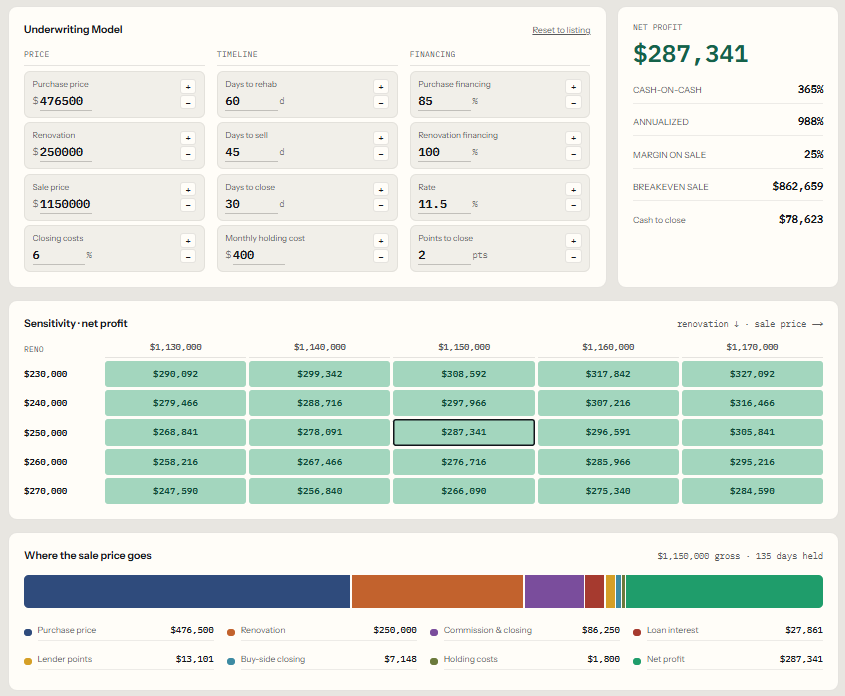
Have a deal you’re weighing? Send it to me and I’ll send it to you in this same model.
Why The Big Flip Might Be The Safer Flip
Most investors think cheap homes are the safer play - lower downside risk. If it all goes wrong, you’re only out 250k, instead of 750k. This might be true - but that’s the sort of risk underwriting you only consider if you think you’re on the edge of one of the great market tumbles in history, like the day before the mortgage crisis hit, or the day before Black Friday leading into the Great Depression. For most of us, the actual risk is bracketed by the value of the real estate we bought - and it only goes as deep as the mistake we make, which on a normal house might top out at 100k. With that perspective - on a 250k flip with a 30k margin, 100k is dangerous, while it’s kinda a non-issue on a flip with a 1.2M sale price and 280k in margin. Worst case scenario you just make less money, instead of going completely upside down.
What the Data Says: High, Middle, Low
This plays out in various places across the country, but let’s use Phoenix as the sample market. Overall in Phoenix, it’s a buyers market. The Cromford index was around 81 at mid-year, firmly in buyers market territory, with supply outpacing demand. The imbalance is driven by demand weakness, not excess supply. We all can see that there are not enough people buying.
If you segment all of Phoenix into price tiers, you see a very different story. Over the last 12 months, you get this:
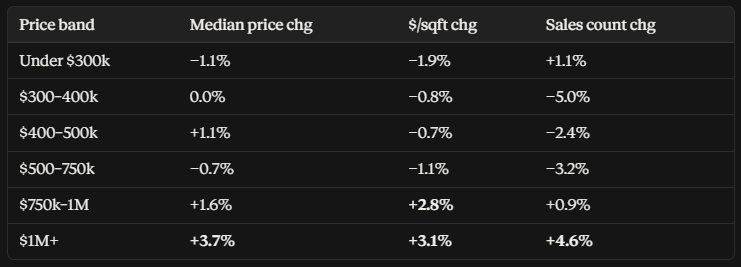
Both prices AND sales volume are up on the $1M+ cohort, and either flat or down elsewhere.
Why Investors Haven’t Chased These
It takes more capital, more timing, more equity, and more skill. The construction projects are bigger, and the number of players you need expand (architect and designer just don’t pencil on 35k flips in the 400k price point).
The buyer pool is smaller. There are fewer buyers AND homes above $1M than in the other cohorts. If you miss, you sit for a long time.
Design matters. at $400k, they want it “updated” and clean. At $1M, they want specific fixtures and appliances and trendy slabs of stone that match their Instagram feeds.
Mostly, it feels scarier because it’s bigger. We all compute risk management in our heads, without thinking about it, and sometimes our intuition gets it wrong.
Why Investors Should Buy Luxury Projects
Because prices are holding steady. Because as inflation eats the lower and middle class, the upper class still sits comfortably with money. Because less competition means better starting prices. Because old homes exist that you can buy for $476k that can be worth $1.2M if you do them right.
In a market where the bottom is paying buyers to close, the top is a much more rational bet for investors with capital and an appropriate understanding of the risks.